Our Mission
Swiss Fire Protection R&D AG, the developer of the Pi Foam System, wants to change the oil and chemical industry by raising awareness about the new potential for saving lives and property – our #1 priority.
We aim to revolutionize the way firefighters battle combustible-liquid fires. First, we do it fast: We have reduced the duration of storage-tank fires from days to just π minutes. There is no tank damage and virtually no air pollution. Second, we care for the environment: The Pi system introduces the foam directly into the tank, avoiding any updraft loss and instantly cooling the tank walls. There is no foam spillage and no soil contamination, which usually poses a much graver threat to the environment than air pollution during firefighting operations.
We offer a non-toxic, biodegradable foam that is infinitely more environment-friendly than the traditional foams currently used by other systems. We can also equip the system with standard commercial foams if the client so desires.
When fire strikes, time is of the essence. The Pi Foam System extinguishes fire and eliminates danger instantly. The system operates automatically and does not put firefighters’ lives at risk.
Uncompromised performance was key from Day One. We have managed to accomplish just that.
Are you sure you can keep your people and your facility safe?
The safety and health of employees is the number one priority for every company. The Pi Foam System is the safest and the most effective fire-extinguishing system on the market. Our revolutionary technology will usher in a new era of safety and quality in the oil and chemical industries – an era where the consequences of large-scale accidents are marginal.
In our opinion, a safety professional at a storage terminal should be like a ghost. Mind everything, be everywhere – but remain unseen. The workers and nearby residents need to know that they are safe, no matter what. Storage tanks are high-risk facilities. They contain flammable petrochemicals in large quantities. The company’s duty is to keep everything and everyone safe. Are you able to control any fire at your storage-tank site, no matter what the circumstances?
Research shows that everyone thinks that they have the right tools to extinguish any storage-tank fire. Well, think again! In most cases, local fire units are the first to respond to industrial-fire incidents. Small fire brigades generally lack the resources and training to handle fires of such magnitude as a full-surface storage-tank fire. Their best option is to secure the area and focus their resources on cooling adjacent tanks to prevent the fire from escalating. A controlled transloading of oil in the tank is also a good strategy, when applicable.
It may be frightening to realize, but most tanks that store flammable liquids lack even minimal fire protection, according to informed sources. If a full-surface fire breaks out, it can easily endanger the entire site and everyone living nearby. The scale of the disaster rises exponentially if a fire spreads from one tank to others.
The Pi Foam System reacts instantly, putting out fires before they cause catastrophe.
Introducing the Pressurized Instant (Pi) Foam System
The Pressurized Instant (Pi) Foam System offers an unprecedented, compromise-free solution to storage-tank disasters. It sets a new standard in the oil, chemical, pharmaceutical and vegetable-oil industries. We offer a variety of foam compounds, each of which is tailored to the specific fire hazards that threaten each individual industry.
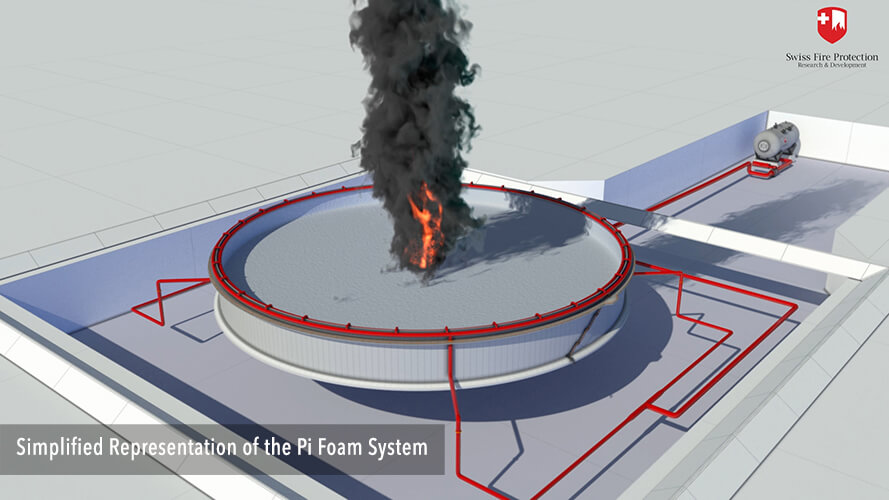
The Pi Foam System can also protect storage tanks from sabotage or terrorism with a special option that addresses these extreme risks.
The Pi Foam System represents the third and fourth generations of Swiss Fire Protection AG’s original firefighting system, known as “Foam Fatale.”
Handling Any Situation
Extreme weather, technical malfunctions, sabotage or a chain of mishaps can all touch off a full-surface fire. Your extinguishment capacities determine whether you can save your burning tank and prevent the fire from escalating, wich may threaten your entire facility. The question is, have you got what it takes to extinguish a fire?
If a fire ignites one of your tanks… your options narrow down. You must regain control of the situation using the best you’ve got. You rely on prevention technologies — lightning-protection devices, advanced roof structures – to avoid such incidents. A low-level fire-intervention protocol may prevent the incident from escalating into a devastating crisis. Your options may include mobile fire brigades, low-capacity rim-seal fire protection systems, etc.… but what if they all fail?
If a fire ignites one of your tanks… your options narrow down. You must regain control of the situation using the best you’ve got. You rely on prevention technologies — lightning-protection devices, advanced roof structures – to avoid such incidents. A low-level fire-intervention protocol may prevent the incident from escalating into a devastating crisis. Your options may include mobile fire brigades, low-capacity rim-seal fire protection systems, etc.… but what if they all fail?
A conventional fixed system with the minimum recommended foam-application rate is able to extinguish rim-seal fires. A fixed, automated rim-seal fire-protection system is the bare minimum every site must have. If a full surface fire were to occur in a tank larger than 40m/131ft in diameter, basic protection systems won’t make much difference – such fires are just too powerful. If the basic systems can’t muster the combined extinguishment capacity to overpower the fire, the firefighters’ only option is to allow a controlled burn-down while cooling the surrounding tanks to prevent the fire from spreading.
For example, under NFPA 11 standards, traditional fixed fire-extinguishing systems must maintain a foam intensity of around 4 L/m2/min (0.1 gpm/sqft) for 30 minutes, which means 120 L/m2 (2.95 gal/sqft) altogether. The Pi Foam System can introduce the same amount of foam to the tank in three minutes (40L/10.6gal for three minutes). That means the foam does not break down and smothers the fire before it can inflict significant damage on the tank.
Mobile emergency units (e.g. Williams Fire and Hazard Control) have the equipment, experience, and strategies that give them a fighting chance against large full-surface fires. Specialized emergency units are able to scale up their foam-application capacity with powerful monitors, pumps, and proportioners. If circumstances are ideal – the fire doesn’t spread, there is sufficient water, conditions don’t worsen – they can extinguish a fire within a few hours, or at least help control the situation and prevent it from escalating.
But there are three important factors to consider:
- The time it takes for firefighters to arrive on the scene
- The resources available to them
- The damage the fire will inflict on the tank and the site while waiting for firefighters to arrive and prepare.
The Pressurized Instant Foam Fire-Protection System is a fully automatic tank-fire fighting technology that can put out fires in three minutes, irrespective of the tank size and weather conditions. It makes no difference whether the tank is in a desert or the temperature is minus 40°C/°F. There is no need for water networks, electricity or specialist firefighting crews.
All-Around Complex Protection
It may be shocking to hear, but the leading lights of the storage tank fire-protection industry often oppose major technology improvements.
This may sound like a paradox. Fire safety is one of the most technology-driven industries, and yet the majority of market players have been offering the same mechanics for 30 years. Unfortunately, if you think about it… it starts to make sense. Precisely because the fire-safety industry is so technology driven, every vendor must always be perceived as top notch. If a completely new, more reliable, affordable and effective technology comes around, it disturbs the established supply chain.
Either everyone must switch to the new technology – tacitly admitting that it’s better than what they’ve been selling so far – or try to discredit it. If you look closely, you see that system designers have been making only incremental improvements and updates for decades. And these systems have repeatedly failed to handle large-scale incidents.
Having specialized emergency units on hand greatly increases your chances of controlling or even extinguishing a full-surface fire. Since these teams have greater capacity, they can effectively isolate the fire if it hasn’t spread by the time they arrive. The costs and losses for your company are still very high, albeit lower than they would be in other scenarios. A system that qualifies as “emergency-level” must quickly extinguish even the largest full-surface fires without external intervention. This depends on two factors: The method of applying the foam and the attainable foam-application rate.
In order to quickly attain the critical foam-blanket thickness on the surface of the burning liquid, the foam must be applied much faster than it burns away. This means the foam must be introduced directly onto the burning liquid surface from all sides. The larger the size of the tank, the larger the foam-application capacity must be.
When fire strikes, time is of the essence. To put things into perspective, our system can even extinguish a 120m/394ft diameter storage-tank fire easily, without a water network or electricity, in less than three minutes. The Pi Foam System is the innovative fire-extinguishing system of the 21st century. Your storage tanks, terminals or oil rigs will stay safe all day, every day.
Standards
There is usually a certain delay before a new technology appears in the relevant industry standards. In most cases, the standards only acclimate to innovations, along with their technical requirements, once industry players are already using them on a widespread basis. For this reason, the development of a good system is the shared responsibility of the engineer (who designs the system) and the manager (who chooses the engineer), independent of the groups that publish standards. In our view, the standards provide adequate guidance for creating an average system, but a truly state-of-the-art design requires extensive experience and comprehensive knowledge of the latest technologies.
When designing any Pi Foam system we combine this state-of-the-art know-how with the already proven knowledge of the industry, we always incorporate the relevant ISO, NFPA, EN, ASME, ASTM, API, BPVC, PED codes and standards.
Tested by Lastfire using the Lastfire Protocol to assess NFPA 11 equivalency (full report available by request from Lastfire or SFPRD). Under review by NFPA 11.
Tested by Tüv Süd for EN 13565-2 equivalency (full report available by request).
Not Only Tank Fires
We mainly advertise the Pi Foam System as a storage-tank firefighting technology, but it is naturally capable of protecting dikes, pump stations, loading stations for trucks, trains, and ships, and other areas. It offers all-around complex protection for any site where foam is used to extinguish fires.
The Pi Foam System is unlike any other on the market!
It can protect against sabotage. The automatic detection system reacts quickly to any scenario, without depending on externalities such as manpower, electricity or water networks.
The Pi Foam System was developed by engineering geniuses who designed it to be 100% compatible with current firefighting systems.
Once installed, the Pi Foam System can be the “central brain” of your tank farm, distributing foam to all your installations via underground pipelines.
The Pi Foam System is fully capable of accommodating all current foam-dispensing devices, creating a complete next-generation system that supplies all equipment with the required quantity of foam.
This equipment includes foam pourers, foam monitors, hand monitors, foam sprinklers and bare open pipe ends – even devices such as the Circular Injection Ring, which traditional firefighting systems can’t accommodate due to its performance limitations.
The Pi Foam System operates independently as one giant network – and all this for a fraction of the lifetime price of traditional systems.
Biodegradable Foams
Environmental protection is a priority for us. We have therefore developed biodegradable foams that are certified as non-PBT (non-persistent, non-bioaccumulative, non-toxic), do not contain fluorine and are made of natural substances. The Pi Foam System can also be used with traditional foams. For details, see the “Biodegradable Foams” section below.
Costs
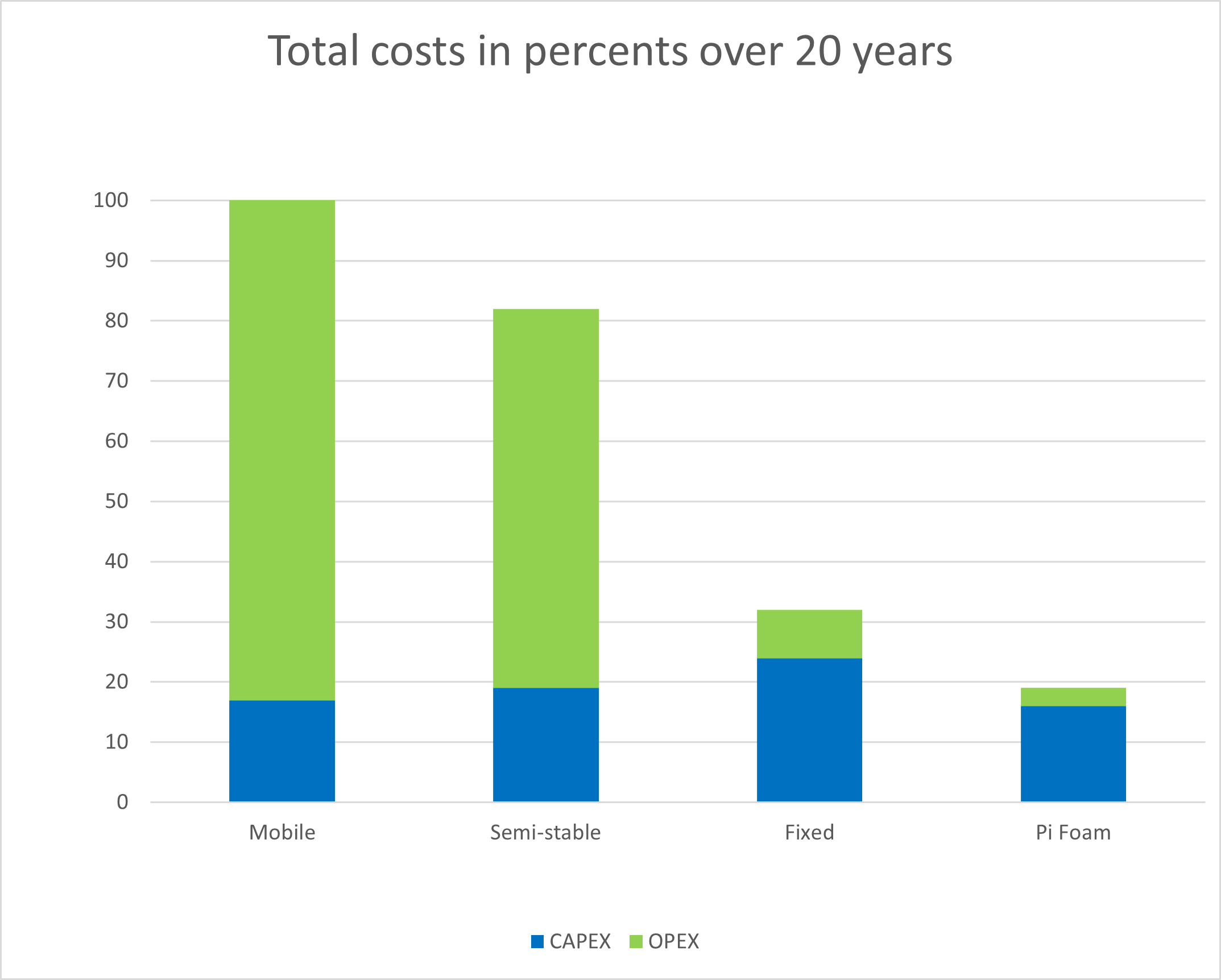
We have prepared a thorough comparative analysis of the costs of different fire-protection systems for combustible-liquid storage tanks. We divided the various technologies into four categories: Mobile systems, semi-stable systems, fixed systems, and the Pi Foam System.
Naturally, the Pi Foam System is capable of protecting not only tanks, but also the dike and other technological areas. However, we omitted these areas from our study because they would have made the calculations inordinately complex and including them would not have affected the final result. We focus exclusively on storage tanks. We conducted a comparative cost analysis for each of the four systems at a medium-sized tank (50m/164ft-diameter) in a medium-sized storage facility (20 tanks). Calculations were conducted in line with industry standards published by the National Fire Protection Association (NFPA) and European Standards (EN).
Our study calculates how many years it would take for each system to provide a return on investment. At first glance, an extinguishment system does not generate profit, so it may be difficult to understand the concept of “breaking even.” However, we can calculate a “break-even” cost by evaluating the dollar amount of damage that would be inflicted by a full-surface fire at a single storage container at the tank farm described above. We then multiply this by the annual statistical probability of such a fire occurring. This theoretical cost of a fire event became our “alternative cost,” or the cost of “risking it” by failing to install a fire-extinguishment system. We then compared this cost to the annual OPEX for a single tank equipped with one of the fire-extinguishment systems in our survey. If the annual OPEX is greater than the “alternative cost,” then the system will never break even. However, if there is a “profit” – that is, if the system’s annual OPEX for a single tank is less than the cost of “risking it” for a year – then we calculated how many years it would take for the investor to break even on the CAPEX for installing the system.
Among the three traditional technologies, mobile systems have the lowest upfront investment cost. However, the cost of salaries for an on-site team of firefighters, on duty 24 hours a day, makes this the most expensive option in the long term. Over a 20-year period, maintenance and operational expenses and the total expenses will be the highest. And since the OPEX is higher than the alternative cost of risk, the investor will never break even.
Now, the benchmark will be the mobile system cost, as 100%.
Installing a semi-stable system is somewhat more expensive, but the operating costs are almost as high as those of a mobile system. Over 20 years, total costs will be 20% less than with mobile system. Thanks to the high OPEX, the investor will never get a return.
A fixed system incurs the highest installation costs. It also operates automatically, meaning it can be maintained with minimal human resources. However, the complex machinery requires a considerable amount of maintenance. Over 20 years, total costs will be 70% less than with mobile system. Here, we can finally discuss a return on investment, because the OPEX is lower than the alternative cost of risk. An investor would break even in approximately 15 years.
The Pi Foam system qualifies as a fixed-automatic system, without the complicated machinery of a traditional fixed system. This means savings on the OPEX side as well as significantly greater operational reliability.
Maintenance is incredibly simple. The system monitors its own pressure and sends a signal if it detects a problem. Otherwise, the only maintenance required is regular functionality tests on the valve and an annual foam sample to check for proper consistency. These costs come to less than a few thousand USD a year. Over 20 years, total costs will be 80% less than with mobile system.
Since this system offers the lowest installation and maintenance costs of all the systems in our study, the time required for an investor to break even is also very advantageous – just seven (7) years.
We believe the most important lesson is that it is always worthwhile to thoroughly evaluate a firefighting system from a professional and financial standpoint, even if it appears to be the most expensive at first glance. This is especially true when discussing a technology as efficient and low maintenance as the Pi Foam System. For those who would argue that a fixed-extinguishment system cannot respond to all types of fire events (a problem that we believe can be resolved through proper design), we suggest that the best price-value option would be the Pi Foam System’s instant-reaction capabilities (no preparation time required) combined with keeping a smaller-capacity mobile fire brigade at the ready.
If you are interested in additional details, we invite you to download the case study below.

Downloadable Financial Study